Studio venture / Care & community
The Care Exchange: a considered independent care marketplace
Connecting discovery, care bookings, preferences, messages, and carer business tools in a product that makes the next step easier to understand.
Finding support and arranging care involves practical details, personal preferences, and a need for clarity. A care marketplace cannot simply borrow the language and interaction patterns of a generic shopping cart.
The Care Exchange is our independent-care marketplace venture. It explores how discovery, booking, and ongoing coordination can fit into one understandable experience for clients and carers. This is a software and service-design showcase; it does not imply clinical validation or regulatory certification.
The opportunity: reduce the coordination burden
A client needs to understand who offers a service and what happens next. A carer needs to present their services and manage the work they accept. A platform operator needs clearly defined responsibilities and an auditable service model.
We designed distinct client and carer experiences around those needs. Profiles provide service context, discovery helps narrow the choice, and the booking journey gives the next action a clear place. The design aims to make coordination more legible rather than adding another layer of administration.
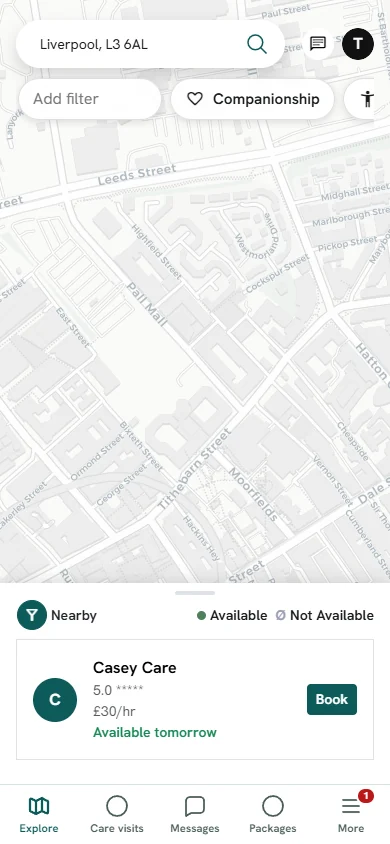
Discovery. Select the screenshot to view it full size.
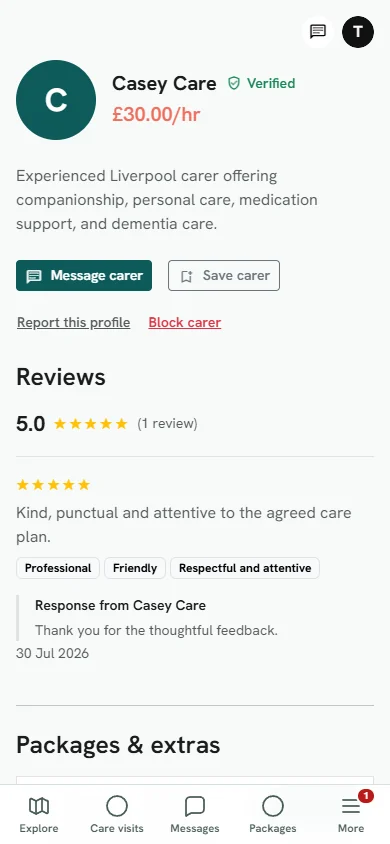
Carer profile. Select the screenshot to view it full size.
Put the working day in context
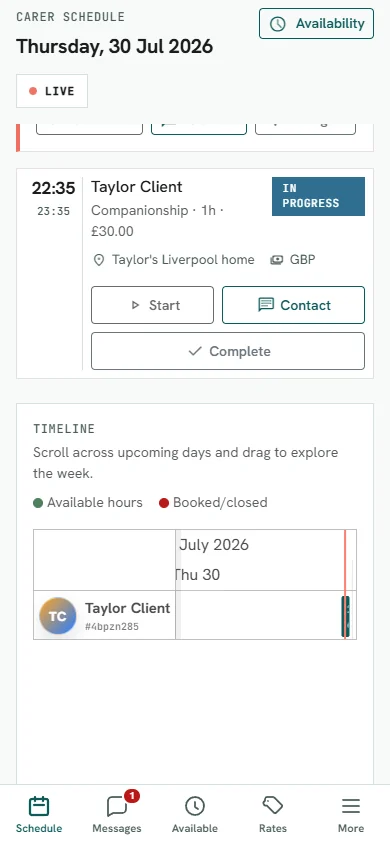
The carer agenda and business tools organise work around dates, bookings, and service offerings. These surfaces are deliberately task-oriented: the user needs to locate a booking or manage an offering with minimal interpretation.
A successful care platform also needs decisions beyond the interface. Eligibility, verification, safeguarding, consent, incident handling, and any regulated activities must be defined with the operator and appropriate specialists. Custom software makes those requirements explicit; attractive screens cannot stand in for them.
Carer agenda. Select the screenshot to view it full size.
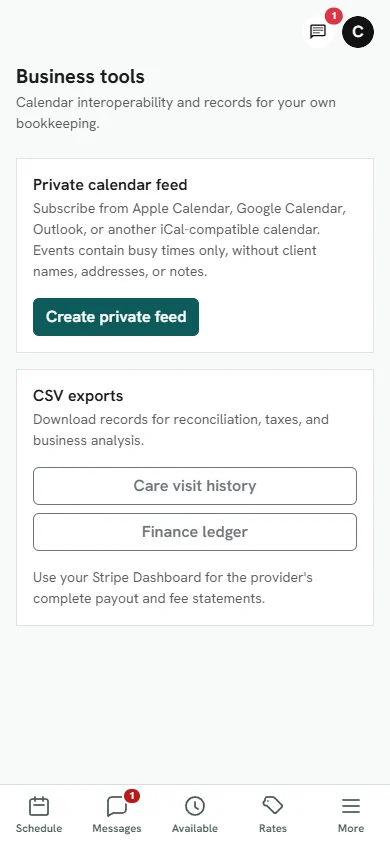
Carer business tools. Select the screenshot to view it full size.
Support the relationship after discovery
Package booking and messaging interfaces show how a marketplace can support an ongoing service relationship. Rather than ending at the moment of purchase, the product gives clients a place to organise bookings and communicate.
The product design considers the different contexts in which people use the service. Clear labels, manageable forms, and mobile layouts help make the interaction approachable. Accessibility and real-world usability still need to be tested with the intended audience as the service evolves.
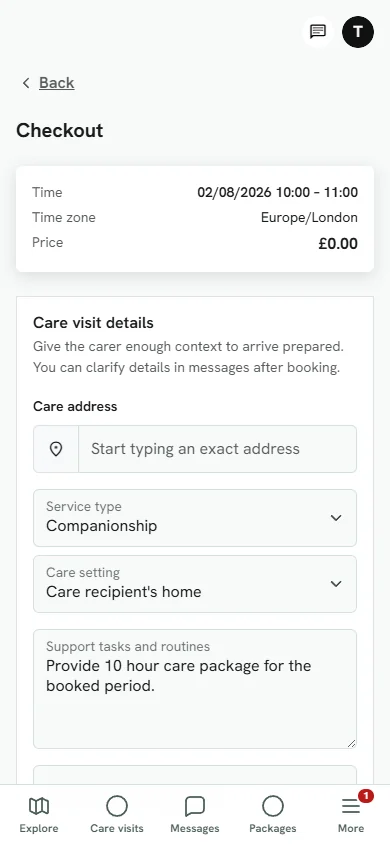
Client package booking. Select the screenshot to view it full size.
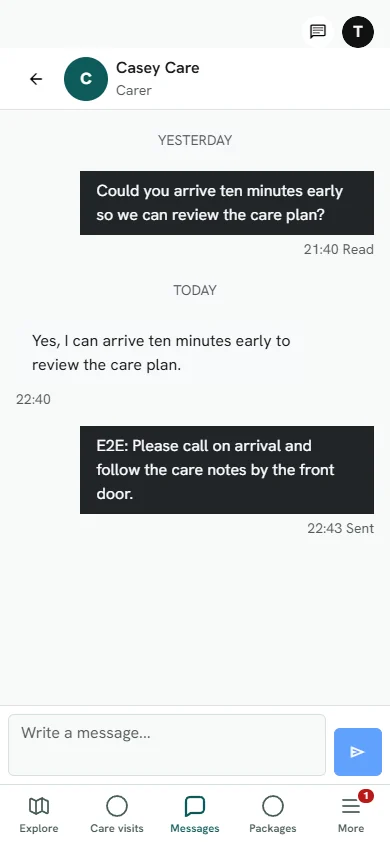
Client messages. Select the screenshot to view it full size.
Engineering with clear responsibilities
The Care Exchange uses Orchard Core for identity, content, and administrative capabilities alongside dedicated marketplace and payment workflows. ASP.NET Core, Blazor, PostgreSQL, and Stripe Connect provide the core platform foundations, with shared UI for web and MAUI hybrid applications.
Role and participant relationships belong in the application model. Data ownership, visibility, and permissions need to reflect the actual service, not assumptions based on who happened to create a record. That is especially important when a product coordinates support between several people.
What this demonstrates
This venture demonstrates a coherent journey across a care marketplace's public and operational surfaces. It shows how a specialised platform can be designed around people and service delivery rather than a collection of disconnected forms.
For a care organisation or marketplace founder, the first useful conversation is about the service boundaries, users, and coordination problems. We can help turn that into a scoped product with a considered interface and explicit technical responsibilities. Discuss your care platform.
Questions about a similar platform
Does this case study claim the platform is clinically validated or certified?
No. It presents the product design and software implementation. Any care-related regulatory, safeguarding, or clinical requirements must be separately established for the intended service.
Can the platform reflect a specific care organisation's workflows?
That is the purpose of a custom engagement. Roles, service offerings, booking rules, permissions, and integrations would be designed around the organisation.
An Optimal Deviation studio venture. Screenshots show product interfaces with demonstration data.